The Basics
A company called Takanock, backed by $500 million from DigitalBridge and ArcLight Capital Partners, is seeking permission to build 18 natural gas-fired combustion turbines and two data center buildings on 160 acres of unincorporated county land near Luke Air Force Base, about 400 feet from the nearest homes and 2,000 feet from the nearest Surprise-area neighborhoods.
The facility would generate 700 megawatts of power. For context, that is enough electricity to power roughly 500,000 homes. The turbines would run 24 hours a day, exhausting through open 72-foot stacks, with no set end date. The project is called Project Baccara.
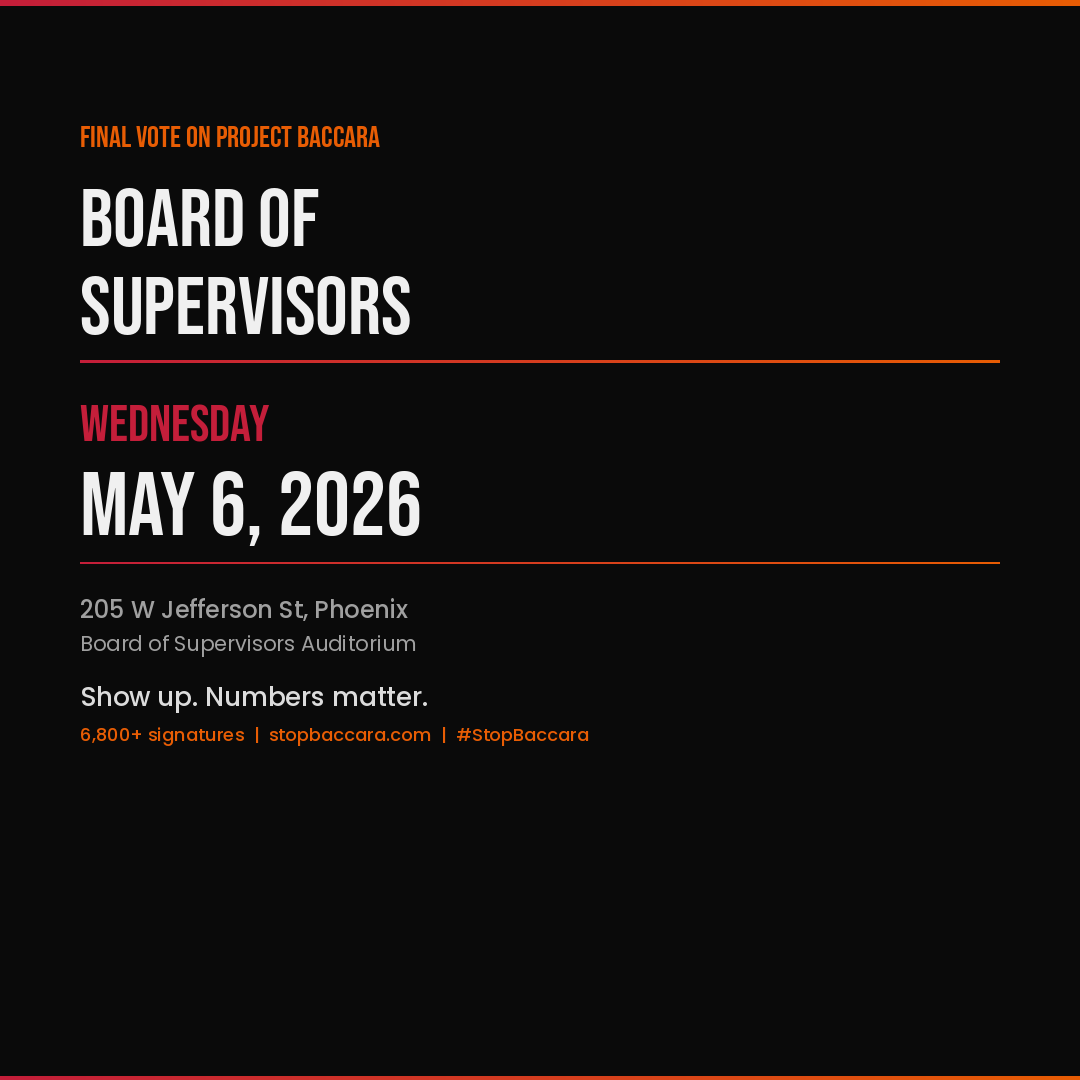
The Arizona Corporation Commission approved the project's environmental certificate 5-0 in February 2026. The Planning and Zoning Commission recommended approval 8-0 on April 9. The Maricopa County Board of Supervisors approved the Military Compatibility Permit 4 to 1 on May 6, 2026, subject to conditions a through p. The MCAQD air quality permit, Plan of Development, and Glendale annexation remain pending.
What the Research Shows
The Surprise Community Coalition has reviewed every publicly available permit document for this project. These are the key findings, each backed by primary sources you can verify.
On March 13, 2026, the Commander of the 56th Fighter Wing at Luke Air Force Base sent a letter to Maricopa County finding the project "not compatible" with base operations unless nine sets of conditions are met. The letter classifies Project Baccara as a "utility" under A.R.S. § 28-8461, which generally restricts utility siting near a military airport. Conditions include electromagnetic and radio-frequency interference shielding, no visible plumes affecting pilot visibility during the approximately 170 daily overflights, no on-site natural gas storage, sound attenuation, and federal reviews by the FAA, FCC, DoD Siting Clearinghouse, and CFIUS. Luke AFB "reserves the right to provide further comment."
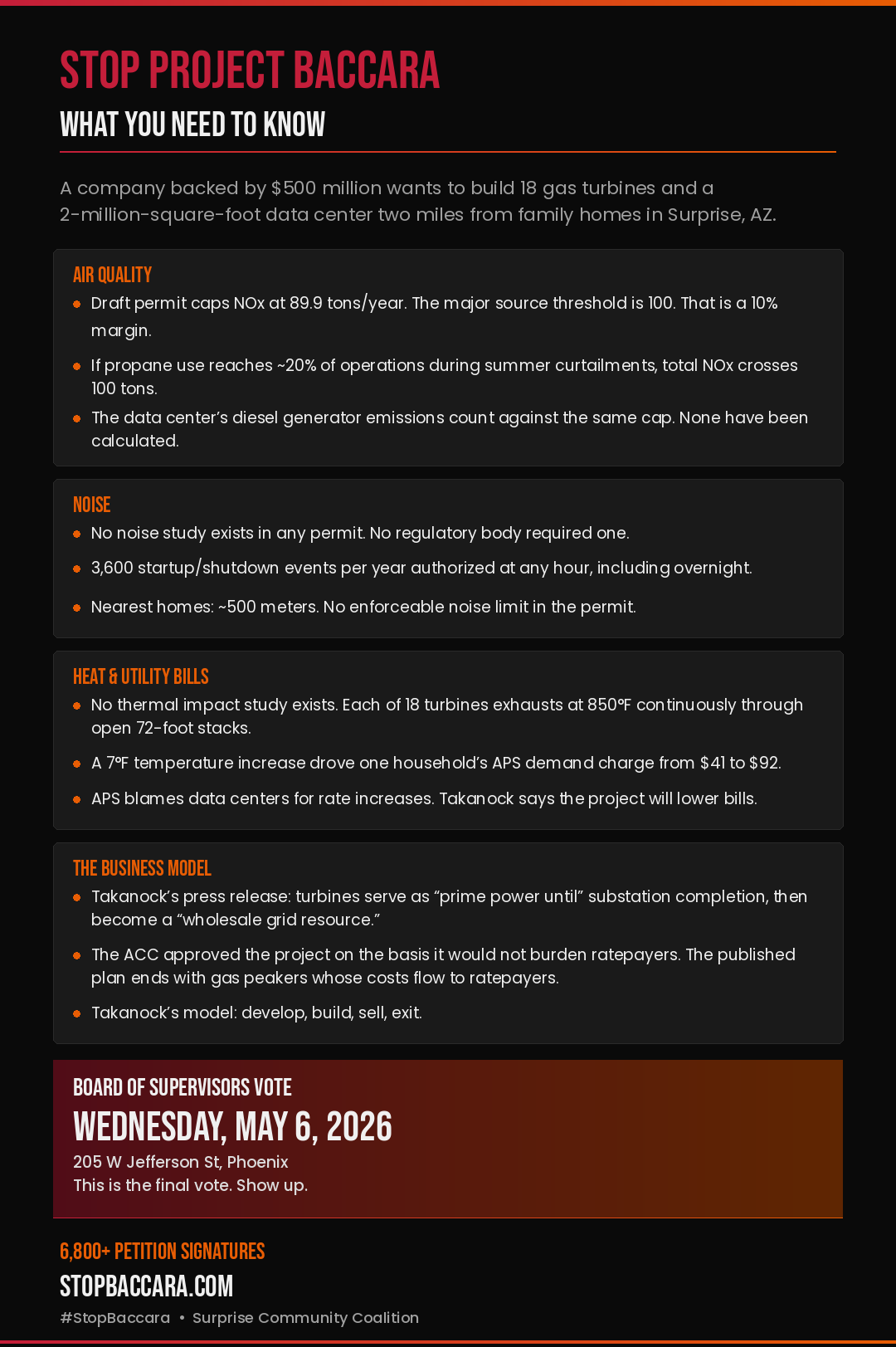
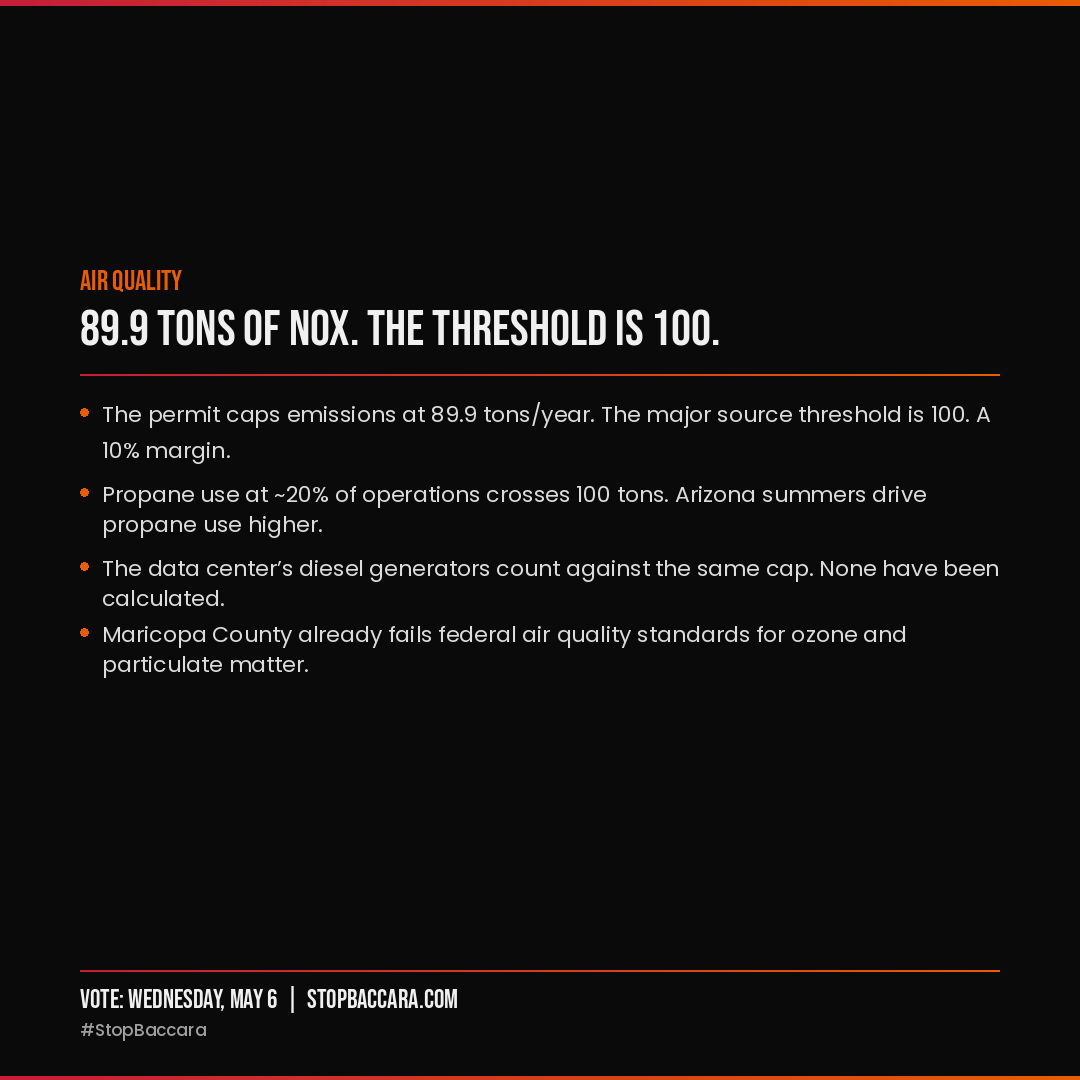
Download the letter (3 pages) → · Read the letter summary →The draft permit caps nitrogen oxide (NOx) emissions at 89.9 tons per year, just 10.1 tons below the 100-ton threshold that triggers stricter federal oversight. Maricopa County already fails to meet federal air quality standards for both ozone and particulate matter. The permit allows propane as a backup fuel; if propane use reaches roughly 20% of operations during Arizona summer curtailments, the facility's own numbers show NOx crossing the major source threshold. The county's air quality department has determined that the data center's future diesel generator emissions count against the same cap. No tenant has been named and no data center emissions have been calculated.
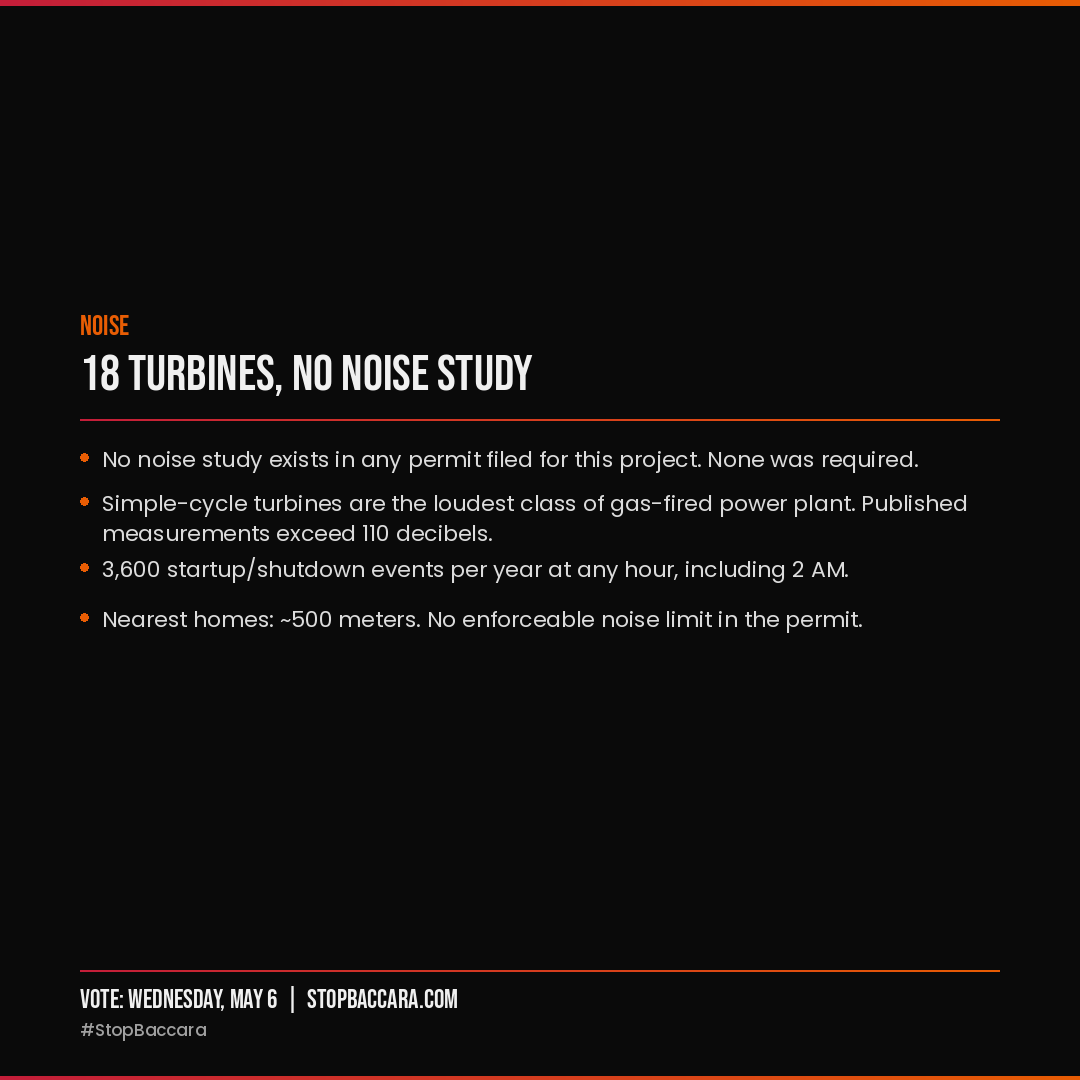
Read the full permit analysis →A 45-page operational noise study was filed with the Military Compatibility Permit application in October 2025, prepared by a firm retained by the developer. It models only continuous full-load operation, not startup or shutdown events. The permit authorizes 3,600 startup and shutdown events per year at any hour, and this equipment class has published measurements exceeding 110 decibels unmitigated. The ambient baseline was measured over a single 24-hour period in August. Every methodological choice in the study moves the result in the same direction: quieter.
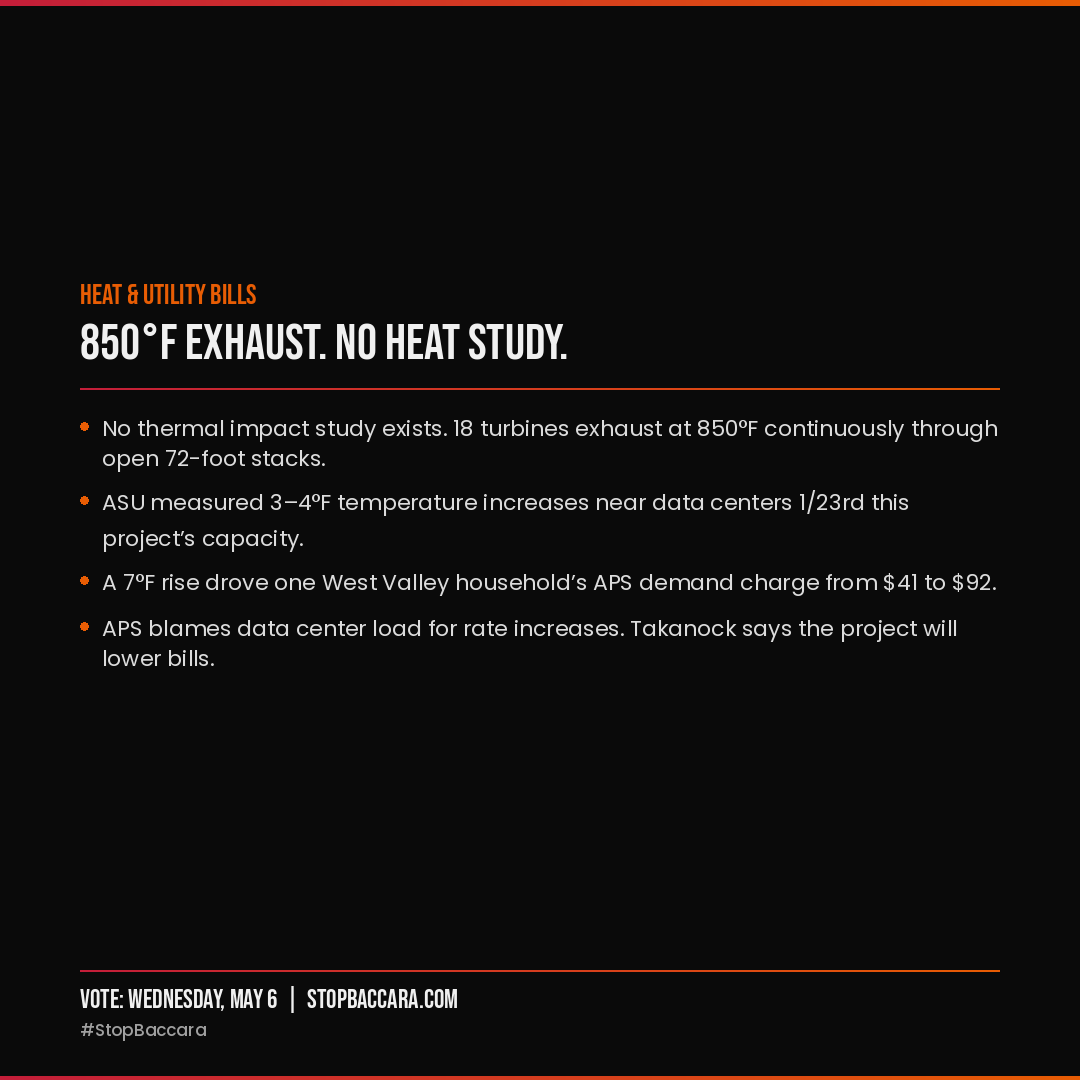
Read the noise analysis →No thermal impact study exists in the permit record. Each of the 18 turbines exhausts at 850 degrees Fahrenheit whenever it runs, at any hour. Peer-reviewed ASU research has documented air temperature increases of up to 4 degrees Fahrenheit downwind of Phoenix-area data centers ranging from 36 to 169 MW, the largest still less than one-quarter of this project's proposed capacity. Actual APS bills from a West Valley household show that a 7-degree increase in average temperature drove the demand charge from $41 to $92 in a single billing period. APS told regulators that data center load growth is driving the need for rate increases. Takanock told media the project will lower residential bills.
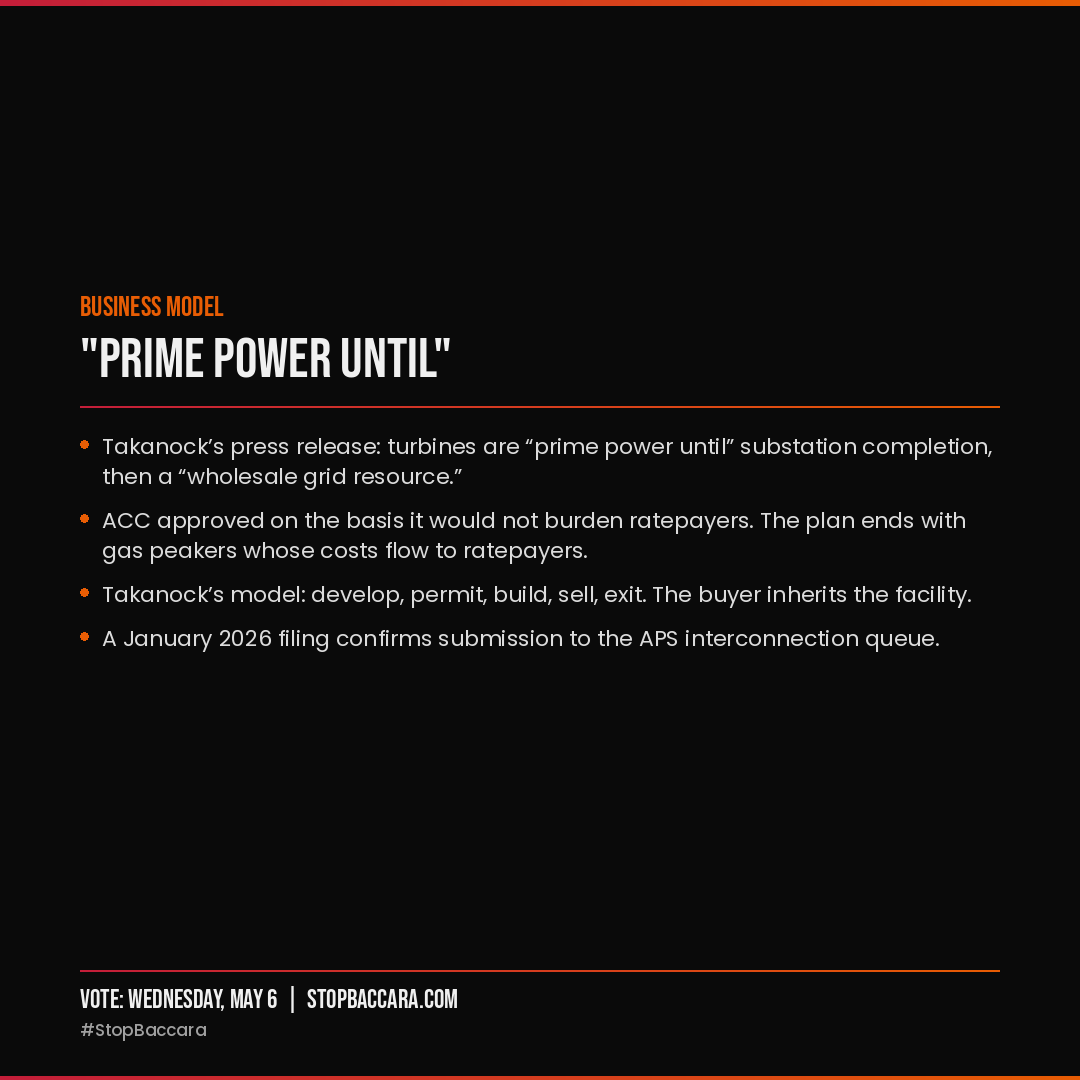
Read the heat and bills analysis →Takanock's own press release states the turbines will serve as "prime power until" a substation is completed, then become a "wholesale grid resource." The ACC approved the project on the basis that it would not burden ratepayers. The published plan describes a facility that transitions to grid-connected gas peakers whose costs flow to APS ratepayers. Takanock's stated model is to develop, build, and sell the site. The buyer inherits the facility. Takanock exits.
Read the business model analysis →Takanock has described the facility's emissions as "well below" major source thresholds. The actual margin is 10.1 tons out of 100, before adding any data center emissions. The developer has claimed the project will lower utility bills. APS's own rate case filing says the opposite. Each claim has been checked against primary sources.
Read the fact check →Where Things Stand
The Military Compatibility Permit was approved subject to conditions a through p. Multiple gates remain before construction can begin.
The MCAQD air quality permit and EPA Region 9 review are pending. The Plan of Development has not been filed. Glendale annexation is in process; the council votes October 27, and under condition (f) of the county approval, annexation would close the county Plan of Development gate. SoftBank completed its acquisition of DigitalBridge on September 30, 2026, after CFIUS clearance; the ArcLight transaction is still pending. Public engagement at each remaining gate is on the official record.
What You Can Do
- Stay informed. The MCAQD air permit, Plan of Development, and Glendale annexation each involve public proceedings. Check stopbaccara.com for updates as each gate approaches.
- Contact your elected officials. Maricopa County Supervisors and Glendale City Council both have roles in the remaining process.
- Sign the petition. Over 11,000 have signed. Add your name.
- Share this page. Text it, post it on Nextdoor and Facebook, send it to your HOA. The more people who know, the harder this is to ignore.
Shareable Images
Download and post these on Nextdoor, Facebook, Instagram, or text them to your neighbors. Long-press or right-click to save.